Fragmented vendors quietly drain budget, speed, and consistency. Here's why an integrated team — spanning web, AI, marketing, branding, and 3D — outperforms the three-agency model in 2026.
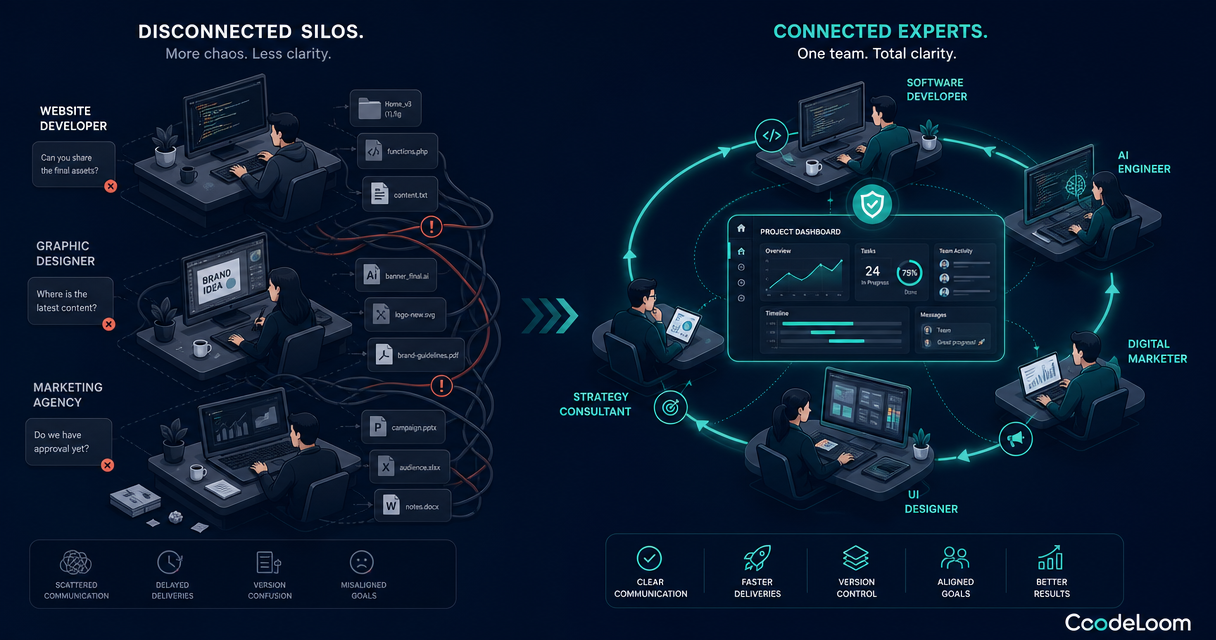
Every week, a business owner somewhere is juggling three separate WhatsApp chats. One with their web developer. One with their social media person. One with the designer who does the brochures. None of them talk to each other. The website does not match the branding. The social media posts do not reflect what the website says. And when something needs updating across all three, the owner ends up doing the coordination themselves, which is not what they started a business to do.
This is not a small problem. It is one of the most common and most expensive inefficiencies in how small and growing businesses manage their digital presence today.
The Hidden Cost of Fragmented Services
Most business owners think about agency costs in terms of what they pay per invoice. But the real cost is what gets lost in the gaps between agencies.
When your web developer does not know what your social media team is doing, you end up with a website that talks about one thing and an Instagram page that talks about another. When your branding designer works in isolation from your marketing team, you get materials that look slightly different each time. When nobody owns the full picture, the client, which is you, ends up owning it by default.
A business that is managing three or four separate vendors is also losing something harder to measure: speed. A unified team that handles your website, your AI tools, your marketing, and your design can move in one direction together. A fragmented setup moves in three directions at once, slowly.
What “All in One Place” Actually Means in 2026
The phrase gets used a lot. But there is a meaningful difference between an agency that offers multiple services through subcontractors they have never met and one that is built around genuine expertise across disciplines.
At CoodeLoom, the foundation is exactly that difference.
Our co-founders bring together two worlds that rarely sit at the same table. Kamaluddin Siddique spent over five years in wealth management and institutional finance at firms including Motilal Oswal and Kotak Securities before co-founding CoodeLoom. That background means every business decision, every pricing conversation, and every client engagement is approached with commercial discipline, not just creative enthusiasm. Alfiya Ali brings the technical engineering layer — front-end development, AI integration, and data science — which means the tools we build are grounded in how software actually works, not how it sounds in a pitch deck.
But what makes the model genuinely different is the partner network built around that foundation.
Global Experience Built into Every Project
One of the most common gaps in Indian digital agencies is international context. Many can build a website. Far fewer understand how a client in Germany expects a project to be managed, what quality standards a US-based business takes for granted, or how the UAE construction and interior design market operates when it comes to technical documentation and 3D visualization.
CoodeLoom’s collaborating partners bring that international exposure directly into client work.
Vikash Jangir, founder of Purvi Design Studio, spent over four years working in the UAE with furniture manufacturers, CNC workshops, and interior contractors before returning to Mumbai. That experience means when a real estate developer or interior design firm needs technical drawings, shop drawings, or furniture detailing, they are not getting someone who learned it from a course. They are getting someone who has delivered it for clients in one of the most demanding construction markets in the world.
Asfak Siddique brings four years of 3D design experience across corporate trade shows and live events, working with brands like Spinco, Galaxy Freight, and Gelco Electronics. Muskaan Siddique brings hands-on digital marketing experience from the broadcast media world, having managed campaigns and promotions for major entertainment channels, alongside a Data Science degree from IIT Delhi.
These are not freelancers hired project by project from a portal. They are specialists who are part of how CoodeLoom delivers work.
The Services That Actually Move the Needle Together
Here is what a single client engagement can look like when everything is connected.
A real estate developer comes to CoodeLoom with a new residential project. They need a brand identity, a website with lead capture, 3D walkthroughs of the apartments, a WhatsApp chatbot that qualifies enquiries automatically, and a Meta Ads campaign to drive traffic to the site.
In a fragmented model, that is five vendors, five briefing conversations, five invoices, and five different people who have no visibility into what the others are doing.
In the CoodeLoom model, it is one conversation, one project plan, and one team that knows how each piece connects to the next. The 3D renders feed directly into the website and the ad creative. The chatbot is briefed on the same messaging as the website copy. The ad campaign links to a landing page that the web team built specifically for that campaign, not a generic homepage.
The result is not just more convenient. It is more effective, because everything is saying the same thing to the same person at the same time.
Why This Matters More Now Than It Did Three Years Ago
Consumer attention is shorter. Competition for that attention is higher. And the tools available to businesses — AI chatbots, automated lead nurturing, performance marketing, 3D product visualization — have become sophisticated enough that using them poorly is almost worse than not using them at all.
A poorly configured AI chatbot that gives wrong answers damages trust. A social media campaign that drives traffic to a slow, badly designed website wastes every rupee spent on ads. A 3D render that does not match the actual product specifications creates problems at the build stage, not the presentation stage.
Getting these things right requires people who understand both the individual discipline and how it connects to everything else. That is the gap CoodeLoom is built to close.
The Practical Starting Point
For most small and growing businesses, the starting point is simpler than it sounds.
It begins with understanding what you currently have, what is working, what is not, and where the biggest gaps between your digital presence and your actual business are. That is a conversation, not a commitment. And it is the kind of conversation that is worth having before spending another month paying three separate vendors to work in three separate directions.
If you are ready to have it, CoodeLoom is at coo-de-loom.online.
Choose Your Reading Experience
Whether you prefer an immersive online experience or a professionally designed executive summary, we’ve made both available.
Read Online
Experience the complete interactive article with animations, architecture diagrams, comparison tables, live charts, calculators, expandable sections, and rich visual storytelling.
- Interactive Charts
- Architecture Diagrams
- Performance Visuals
- ROI Calculator
- Animated Stats
- Sticky Navigation
- Related Articles
- Search Optimized
Executive PDF
Download a beautifully designed executive report optimized for business leaders, client presentations, management meetings, and offline reading.
- Executive Summary
- Key Insights
- Business Recommendations
- Professional Charts
- Architecture Diagrams
- Comparison Tables
- Checklists
- Action Plan
- References
- Printable A4 Layout
Approx. 2–4 MB · Print-ready A4
Still prefer reading online?
Continue exploring the complete interactive experience with diagrams, calculators, FAQs, and additional resources.

Written by
Kamaluddin Siddique
Founder & CEO, CoodeLoom
Helping businesses grow through technology, AI, automation, software development, and digital transformation.